Caring for BMW leather starts with knowing whether it's Dakota, Vernasca or Merino
Daniel von Detailing1 |


Koch-Chemie
Interior Scrubber Interior Cleaning Pad

SONAX
PROFILINE Interior Sponge "Duo" Application Sponge
Interior Sponge "Duo" — Applicator sponge with 2 functional sides


GYEON
Q²M ScrubPad EVO Cleaning Pad for Interior


Koch-Chemie × COLOURLOCK
COLOURLOCK "Nubuck Eraser Block" Cleaning Eraser for Suede
What are interior cleaning pads? Handy pads that, together with interior cleaner, lift dirt out of the grain of plastic and leather, plus a dry eraser for suede-type leather. A towel then picks up the loosened dirt. Piano black, displays and high-gloss surfaces don't belong under a pad.
Interior cleaning pads are hand tools that give the cleaner the friction a towel can't. The scrub pad has a rough, brush-like side that pulls dirt out of recesses; two-sided pads like the GYEON pad add a foam side that collects dust. Then there's the cleaning eraser, which cleans suede-type leather dry and spot by spot. Both sit between the microfibre towel and the interior brush.
Detailing1's tip from the shop: Before the pad goes anywhere near the visible door card, test it where nobody looks, such as low down on the door pocket or on the side of the seat facing the centre tunnel. A few passes with cleaner and light pressure, let it dry, then look at it in side light. If the spot looks glossier or duller than its surroundings, the pad is too aggressive for that surface. Koch-Chemie explicitly mentions the compatibility test in the data sheet for its scrubber.
A cleaning pad works where a microfibre towel only wipes over the peaks of a surface and the dirt stays put in the recesses of the grain.
Grain is the fine, embossed texture on plastic trim and leather. It looks like a landscape of tiny hills and valleys. On the hills, a towel wipes the dust clean away; in the valleys, skin oils, road dust and old dressing residue build up. How you notice it: the trim looks clean after wiping, yet still looks grey in side light.
A scrub pad is a pad with a rough, brush-like working surface. The fibres reach into the valleys of the grain and work the cleaner there, which on its own would just sit on the surface. In practice: the chemistry loosens, the pad brings it to the dirt, and you don't have to press harder than you would with a towel.
More pressure on the towel doesn't replace the pad. A compressed towel goes flat and smooth, barely reaches the valleys of the grain even with force and just pushes the loosened dirt from hill to hill. The pad, on the other hand, brings the friction through its surface, not through your hand. For you, that means the same or less pressure and more effect in the texture, visible as grey foam on the pad.
The pad shares this job with two neighbours. The microfibre towel stays the tool for smooth surfaces and for picking up. The Interior brushes take on carpet, fabric upholstery, seams and edges, and on leather a leather brush works the cleaner into grain and seams with its bristles. The pad brings friction to the surface with flat contact. On smooth leather, both are equally good routes, each with leather cleaner and a towel afterwards.
Interior cleaning pads come in two designs that don't replace each other: the scrub pad for plastic and leather and the dry cleaning eraser for suede-type leather.
The two-sided pad splits loosening and picking up within one tool. On the GYEON Q²M ScrubPad EVO, the white side is the scrub surface and the black side a foam that collects loosened dust. GYEON describes the pad as fully synthetic. Other manufacturers achieve the same division of labour with a nylon side for working in and a microfibre side for picking up. The principle is the same for all of them; how hard the scrub side is can vary by manufacturer.
Size is part of the design. At 8 × 10 cm, the GYEON pad sits flat in your hand and covers a door pocket front or a seat bolster in a few passes. For seams and tight corners that surface is too big, and the brush takes over there. A large pad on a small surface spreads pressure unevenly, because only one corner touches down and all the force lands there.
The cleaning eraser is a type of its own. It works without cleaner and without water and picks up surface dirt from the nap. Nap is the layer of raised fibre ends that gives nubuck and suede their velvety feel. For you, that means: where moisture would leave rings, you work dry with the eraser, spot by spot.
The melamine foam sponge doesn't belong in this family. It looks like a white sponge but works through a hard, open-pored structure that removes the surface microscopically. On glossy or coated material, that leaves a dull patch. The melamine sponge sits under Sponges, applicators and cleaning pads, with its own classification there.
Which cleaning pad you use is decided by the material of the surface, not by how heavy the dirt is, because a scrub side that's too aggressive does damage even on lightly soiled surfaces.
Grained hard plastic on door cards, centre console and seat backs is the core territory. In a car care forum in 2024, users described scrub pads on normal hard plastic as unproblematic, even with some pressure. If the trim is matte and finely grained, keep the pressure low anyway, because the texture is meant to get clean, not smoother.
Within plastics, it pays to look twice. Seat backs are often more coarsely grained and take scuffs from shoes; there, the pad works with cleaner in several overlapping passes. For sill plates and pedals, Koch-Chemie names a stiff interior brush, and the pad is at most an alternative there. Trim in high gloss or piano black looks like plastic but belongs on the smooth side. Those parts stay with the towel, even when they sit right next to the grained surface.
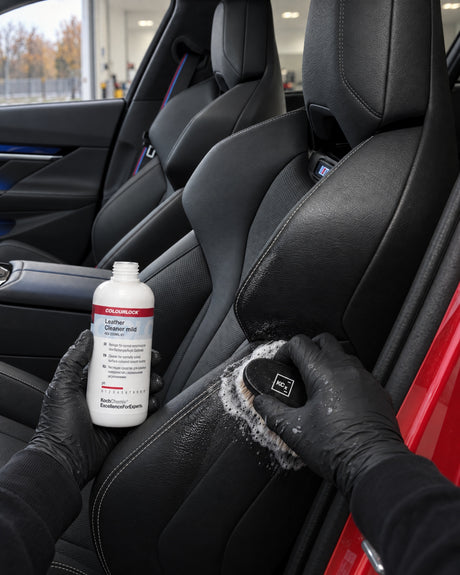
Smooth leather tolerates the pad but needs restraint. GYEON and Koch-Chemie explicitly list leather as a surface. Work there with a suitable Leather cleaner, light pressure and short passes. On delicate or re-dyed leather, a test on a hidden spot decides before the seat itself gets done.
Suede-type leather such as nubuck and suede gets no scrub pad. That's where the eraser works, dry and only on the individual spot. Alcantara isn't suede leather but a microfibre with its own care route. The manufacturer advises against heavy rubbing and steam, so no scrub pad goes there either. How to lift the nap afterwards is shown in the post Cleaning Alcantara without ruining the nap.
A cleaning pad works in three steps: cleaner on the pad, work a limited section, pick up the loosened dirt straight away with a clean towel before it dries on.
Put the Interior cleaner on the pad or on a towel instead of directly on the surface. The manufacturer of Alcantara recommends this for its covers, and in the interior it's generally the cleaner way to work: no overspray on the glass, the display or the speaker grille. The pad is damp, not wet.
Work a section with a natural boundary, such as a door pocket front up to the edge or a seat bolster up to the seam. Move the pad in short, overlapping passes and let the scrub side do the work. If the foam on the pad turns grey, that's the dirt out of the valleys of the grain.
Right after that, pick up the loosened dirt with a clean Microfibre towel. Koch-Chemie writes exactly this second step into the data sheet for its scrubber. After the job, rinse the pad out, in clean water according to Koch-Chemie. Whether a pad can go in the washing machine is up to the manufacturer; Koch-Chemie, for example, rules that out for its scrubber.
If the cleaned surface is to get a dressing, wait until it's dry and apply the dressing with a separate Microfibre applicator, not the cleaning pad. That way, the dirt the pad has picked up stays where it belongs and doesn't end up in the fresh layer of dressing.
A scrub pad doesn't belong on piano black, displays or high-gloss trim strips, because any rough working surface can leave visible marks on smooth, glossy material.
According to forum voices, soft-touch and coated surfaces need the same caution as the surfaces in the Koch-Chemie data sheet. There, work with a soft microfibre towel only dampened with cleaner, and in edges with a soft brush and no pressure.
That also includes the clear cover of the instrument cluster and touch surfaces on the centre console and doors. They're smooth and sit exactly where your hand slips while scrubbing the neighbouring surface. At these transitions, work with the edge of the pad away from the glossy part, never towards it. If some residue is left at the transition, take it off with the towel.
Even a scrub pad doesn't work entirely without abrasion. In the same forum discussion, one voice advises against working the same spot over and over. In plain terms: trim you scrub at every clean can lose its grain over time and start to shine. For regular upkeep the towel is enough; the pad comes in when dirt has set into the texture.
No interior pad belongs on paint. A community discussion from 2026 shows a painted motorcycle tank with scratches after a scrub pad. For paint there's clay, polish and a wash mitt.
Scrubbing without cleaner is just rubbing. A dry pad pushes dust across the surface and rubs it into the grain instead of loosening it. The exception is the eraser on suede-type leather, which is built exactly for dry use.
For grained plastic and smooth leather, a scrub pad is the right cleaning pad; for nubuck and suede, the dry eraser; for smooth, merely dusty surfaces, a microfibre towel is enough.
If door cards, centre console and seat backs look grey even though you wipe them regularly, the dirt is sitting in the grain. Then the GYEON Q²M ScrubPad EVO with interior cleaner is your tool. If leather seats go dark in the grain, use the same pad with leather cleaner and less pressure, or a leather brush, both followed by the towel.
If you're buying interior cleaner and pad together, remember the third part: a stack of clean microfibre towels for picking up. A whole interior quickly gets through several towels, because a grey towel only spreads the dirt around. Lay the towels out before you start so there's a fresh side to hand after every section and you're not searching with the pad in your hand.
If a nubuck steering wheel or a suede seat panel shows individual spots, reach for the COLOURLOCK "Nubuck Eraser Block". For suede-type leather as a whole, for cleaning with liquid and for the question of when a spot is actually wear, the COLOURLOCK guide Nubuck and suede shows the whole route.
If your surfaces are smooth and only dusty, you don't need a cleaning pad. A microfibre towel with a little cleaner does the job, and a pad would only add extra friction there. For carpet, floor mats, fabric upholstery, seams, sill plates and pedals, the interior brush stays in charge. Which surface gets done in which order is in Interior cleaning.
In the end, one detail decides that isn't printed big on any packaging: a cleaning pad only moves dirt around as long as nobody picks it up. The scrub side pulls it out of the grain, the towel right after takes it away. Skip the second step and the loosened dirt gets rubbed back into the texture as it dries. With the towel in your other hand, the pad becomes a tool that leaves the trim genuinely clean.
Too much choice in Interior cleaning pads? Get help picking:
Add Detailing1 as a preferred source on GoogleA scrub pad is a cleaning pad with a rough, brush-like side that, when used with an interior cleaner, loosens dirt from the grain of plastics and leather. According to the manufacturer, the second, black foam side of the 8 × 10 cm GYEON Q²M ScrubPad EVO collects dust. A microfiber cloth is then used to pick up the loosened dirt.
With a cleaning eraser like the COLOURLOCK "Nubuck Eraser Block". Vacuum up loose particles first, then work dry, moving in circles with one corner over the individual spot, and stop in time to ensure the nap is not damaged. Alcantara is not suede and has its own care method, which is shown in the article Cleaning Alcantara.
The cleaning pad works with a flat surface on grained areas like door panels, center consoles, and seat backs. Interior brushes take care of carpets, floor mats, fabric upholstery, seams, door sills, and pedals. On smooth leather, a scrub pad and a leather brush are equivalent methods: the pad for the surface, the bristles for the grain and seams, both using leather cleaner followed by a cloth.
Smooth leather, yes: use leather cleaner, light pressure, and short strokes, as GYEON and Koch-Chemie explicitly list leather as an application area. For delicate or refinished leather, test first on an inconspicuous area. Suede like nubuck and velour leather should not be treated with a scrub pad; instead, use the dry eraser there. Wipe away the loosened dirt immediately with a cloth.
It can leave marks there, so a scrub pad does not belong on these surfaces. Koch-Chemie explicitly excludes piano lacquer and displays in the data sheet for its interior scrubber, and forum users also advise caution with rubberized and coated surfaces. For glossy parts, displays, and the instrument cluster cover, use a soft microfiber cloth only slightly dampened with cleaner.
No. A magic eraser consists of melamine foam, whose hard structure microscopically abrades the surface and can leave dull spots on shiny or coated material. A scrub pad works cleaner into the grain, and the cloth is then used to pick up the loosened dirt. A pad can also leave marks if you work the same spot too often. Melamine sponges can be found under sponges, applicators, and cleaning pads.
Daniel von Detailing1 |

Daniel von Detailing1 |

Daniel von Detailing1 |

Daniel von Detailing1 |

Daniel von Detailing1 |

Daniel von Detailing1 |

Daniel von Detailing1 |

Daniel von Detailing1 |

Daniel von Detailing1 |

Daniel von Detailing1 |

Daniel von Detailing1 |

Jasper von Detailing1 |