

Tyre dressing doesn't wash off in the rain, it goes wrong at application
It's dry and overcast here in Nordhorn today, with rain on the way from Thursday. Weeks like this are exactly when the Saturday question comes up: why is the tyre dressing grey again after a single wet day? The answer is rarely the rain. It's the chemistry of the product, the state of the sidewall and the ten minutes after you've laid it down.
Tyre dressing lasts exactly as long as the prep, the film thickness and the formulation allow. If you can tell spray, gel and coating apart and properly degrease the sidewall first, you get weeks instead of days.
Why the dressing looks grey after the first rain
Most cheap tyre sprays are water-based emulsions that leave a thin film and re-dissolve as soon as they get wet, which is why the sidewall looks exactly like it did before after two or three wet drives.
That's not a product fault, it's physics. An emulsion needs water to get onto the rubber in the first place. What went on with water comes off with water. In summer, with dry weeks in a row, you barely notice. In autumn, with rain on three days out of seven, the layer is gone after one to two weeks, sometimes sooner.
On top of that, the sidewall itself is working against you. Tyre manufacturers mix anti-ageing agents into the rubber, and these slowly migrate to the surface and oxidise there. That process is called blooming, and it turns the sidewall brown. A thin dressing film covers it for a few days, then the next layer migrates up behind it. How to stop it for good is covered in our post on brown tyres.
Solvent-based silicone oils are the opposite approach. They survive rain because oil and water don't mix, and they deliver the wet look straight away. The trade-off: silicone oil is a dust magnet, turns brownish itself after one to two weeks, and there's an ongoing debate in the trade about whether aggressive solvents pull plasticisers out of the rubber. So rainproof on its own is no mark of quality; what matters is what the layer does to the rubber.
So when the dressing vanishes after the first rain, it usually comes down to three things: a water-based formula, a sidewall that was never properly clean, and too much product that slung off the moment you pulled away. All three are fixable, and none of them costs you more than ten minutes per wheel.
What separates spray, gel and coating on the sidewall
Tyre dressing comes in four chemistries: water-based emulsions, solvent-based silicone oils, polymer-based gels and coatings, and ceramic detailers, and each one builds its layer differently. How long they last on the sidewall varies accordingly.
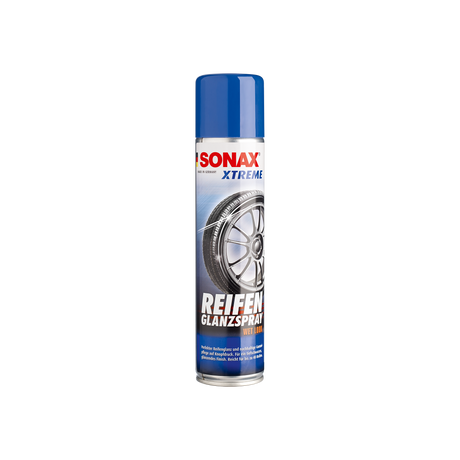
An aerosol like the SONAX XTREME ReifenGlanzSpray "Wet Look" Reifenpflege 400 ml is the fastest route to deep black. A light pass over the sidewall from about 20 cm, wait five minutes, done. The gloss comes from a low-viscosity film that soaks into the rubber surface. The flip side is limited durability, and the car should sit for half an hour afterwards so nothing flicks onto the brakes.
A gel like the Meguiars ULTIMATE "Insane Shine" Tire & Trim Gel Reifenpflege 16 oz (473 ml) works differently. The gel matrix bonds more firmly to the rubber surface and gets washed out by rain and brake dust more slowly than a thin, runny spray. A hazelnut-sized blob on the pad does one sidewall. After three to five minutes you wipe off the excess with a cloth, and the finish evens out.
A polymer coating like the Meguiars Ultimate Insane Shine Tire Coating Reifenpflege 15 oz (386 ml) is the thickest option. Synthetic polymers form a bonded layer that the manufacturer rates at two to six weeks, depending on mileage and weather. The trick is in the application: a very thin first coat, let it flash off for ten minutes, then a second. The coating self-levels and doesn't run.
The fourth route is ceramic. The SONAX XTREME Ceramic Reifen+FelgenDetailer Quick-Detailer 750 ml uses Si-Carbon technology to lay a protective layer on tyre and wheel in one go. On the tyre you're left with a naturally matt finish, no mirror shine, no dust magnet. SONAX rates the layer at up to three months, and you can apply it to a damp or dry sidewall with no rinsing.

Which route is right depends on the finish you're after and your weather window. If you want that rich wet look and you're washing at the weekend anyway, aerosol or gel will do you fine. If you want three weeks of peace in autumn, grab the coating or the ceramic detailer. We've already got a separate post on gloss versus satin; this one is all about durability.
New tyres repel every dressing
Fresh tyres still carry mould release agent from the vulcanising mould on the sidewall, and that slick layer makes water-based dressing bead right off until it has been removed mechanically or chemically.
Strikingly often it's tyres that were freshly fitted and then only ever washed with shampoo. In our experience a sidewall like that looks spotless but feels slightly waxy, and that exact layer keeps every dressing at arm's length. A quick finger test helps: if a drop of water sits on the sidewall as a bead, there's still release agent on it. If it spreads out, the rubber is open.
The pattern crops up in forums all the time: four-month-old tyres, the dressing won't soak in and just sits in droplets on the rubber. From what we see day-to-day, that's not a sign of a bad product but of a sidewall that has never been properly degreased. Waxy release agents and a wafer-thin silicone film from production are stuck fast, and water alone won't shift them.
The fix is a thorough clean with a tyre cleaner or an APC, plus a brush with some bite. If the foam turns brown or grey while you scrub, keep going. If it stays white, the sidewall is clean. Only then can a dressing actually soak into the rubber surface instead of floating on a release layer.
In really stubborn cases, going via a solvent-based product helps because it dissolves the release agents. After that, though, you need to clean the sidewall completely again before any water-based product goes on. Silicone residue and emulsion don't get along, and the result comes out blotchy. The full cleaning sequence is laid out in our post on the right order before tyre dressing.
In our experience the prep decides how long it lasts
A comparison test of 16 tyre dressings concluded that about 80 percent of durability comes down to the prep, and that's exactly what we see on our own cars.
The reason is simple. Every dressing bonds to whatever it finds. If there's old dressing film, brake dust or a trace of blooming still on the sidewall, the new layer bonds to that grime and not to the rubber. Come the first rain, the grime lets go and takes the dressing with it. That's why two tyres with the same product can look completely different after a week.
The sidewall also has to be dry, properly dry. A damp tyre looks clean, but there's still water sitting in the rubber structure. Water-based products can go on wet, but they come out noticeably flatter and need over an hour at 10 °C to dry through. Polymer coatings and gels want a dry sidewall, otherwise the layer won't bond.
At our place in Nordhorn, one order has stuck: spray tyre and wheel, scrub the sidewall with the brush, rinse, wash and dry the car, then get the sidewall dry with an old microfibre or the blower. Only then does the dressing go on. It costs five minutes more per car and, in our experience, doubles the durability, whatever chemistry you pick.
Apply it so thin that nothing slings off
Sling happens when there's too much product sitting on the sidewall and it gets flung outwards as you pull away, so the leftovers end up on paint and wheel. The sidewall itself is left patchy instead of an even black.
A 245/40 R19 tyre needs 1–3 ml of product, no more. With gel that's a hazelnut-sized amount, with a pump spray it's two or three squirts onto the applicator. Anything beyond that isn't in the rubber, it's sitting on top, and that excess is exactly what flies off under the first acceleration. More product doesn't get you deeper gloss, just longer dwell time and spots.
The applicator plays its part too. A Meguiars Tyre Dressing Applicator Pad Applikationspad 1 Stück releases gel and dressing in a controlled way and follows the curve of the sidewall. Before its first use, dampen the pad slightly so the foam takes up product evenly instead of locking it in the pores. A kitchen sponge or a folded cloth, by contrast, spreads product unevenly and leaves streaks.
On tyres with raised lettering or a coarse sidewall texture, the pad won't reach every recess. There, a short brush or a soft applicator brush helps: work the product into the lettering, then pick up the excess with the pad. On smooth sidewalls the pad alone does the job, and you save yourself the second pass.
Daniel: On the black 911 GT3 RS I tested the two front wheels against each other, left applied as always, right levelled with a cloth after ten minutes. After the first rain, the left had sling as a fine mist on the wing, the right sidewall was still an even black. Since then, levelling has been part of every application for us.
Levelling means going over the sidewall once with a clean microfibre after ten to twenty minutes. That takes off the excess, evens out any runs and leaves only the layer that's actually bonded to the rubber. With the coating you dab it off after five to ten minutes, with the gel after three to five. The finish ends up a touch less wet, but it stays.

Spray straight onto the tyre and some of the product inevitably lands on the wheel, the brake disc and in the tread grooves. That's why pump spray and gel always go onto the applicator first, then onto the sidewall. Aerosols are the exception, because they're built for it. Keep your distance there, no closer than 15 cm, or you get a film that's too thick, dries unevenly and leaves drip marks.
Which product suits which weather window
For this week, with rain from Thursday and a dry window at the weekend, a dressing with several weeks of durability is a better fit than a quick spray for Saturday shine.
If you can still work in the dry on Tuesday evening, the coating is the right call. Two thin coats with a ten-minute break, then dab the sidewall down, and the polymers have until Thursday to bond with the rubber. The rain then hits a bonded layer, not a fresh film. The gloss is deep and, from what we've seen, stays visible even after several wet drives.
If you prefer a natural finish or want to do tyre and wheel in one hit, go for the ceramic detailer. Tyre first, then wheel, wipe over with the same cloth, no rinsing. Four wheels take you ten to fifteen minutes. The layer lasts up to three months, which in real terms means you top it up about every third or fourth wash.
If you want that rich wet look on Saturday before the drive out and durability is secondary, the aerosol is still the quickest solution. 20 cm distance, thin and in circles over the sidewall, wait five minutes. If you want more depth, lay down a second, wafer-thin coat after the dwell time. Applied thinly, one can does about 40 tyres.

The gel sits in the middle. It outlasts a spray, shines harder than the ceramic detailer and looks after the exterior plastics on bumpers and sills while it's at it. If you're after one bottle for tyres and plastics, this is the one. But the gel needs a dry, clean sidewall and the right pad, otherwise it goes streaky.
Once temperatures drop below 10 °C, every drying time stretches out noticeably. Water-based products then need a good hour to dry through, and a coating should sit in the garage overnight before it sees rain. If you don't have a garage, plan the application for the first dry day after washing, not the last one before the rain.
Between applications, keeping a bonded layer alive takes very little effort. When washing, just go over the sidewall with shampoo and a soft brush, not the tyre cleaner, because that strips coating and ceramic layer right along with the dirt. Only when the sidewall starts going grey again do you do the full prep and then a fresh layer.
Whatever chemistry you choose: dressing goes on the sidewall, never on the tread. A dressing film in the tread cuts grip, and on a wet road that's not a detail, it's a safety issue. If some does get into the grooves while you're applying, wipe it out straight away with a cloth.
You'll find all four routes in our Tyre Care category, and the matching cleaners and brushes under Tyres and Wheels. If you're not sure which formulation suits your car, drop us a quick line with which tyres you're running and how often you wash. Then we'll tell you whether coating, gel, aerosol or ceramic detailer is the better place to start.
No time for the whole post? Get it summarized: